





What Is Street Interview Advertising? The Format Built For Authentic Marketing And Paid Performance
What Is Street Interview Advertising? The Format Built For Authentic Marketing And Paid Performance
Paid social has a trust problem. Consumers stopped believing the ads years ago. The industry just hasn't caught up.
When a polished creator holds a product in a perfectly lit bedroom, the viewer doesn't look at the product and think they need it. They look at the creator and calculate exactly how much they got paid to say it. That single shift broke traditional UGC. It's bleeding influencer ROAS. And it's why high-growth DTC brands are leaving the studio and going back to the high street.
That's the territory we own. Real reactions. Real results.
What Is Street Interview Advertising?
Street Interview advertising is a paid social ad format built around unscripted, on-camera interviews with real strangers in public. Trained presenters walk up to participants on a UK high street, ask a sharp question, and capture the raw reaction. No actors. No scripts. No retakes. The footage is then cut for paid performance on Meta and TikTok - hooks in the first second, pacing tuned for retention, CTAs engineered for conversion.
You'll see it called a few things across the industry. Street interview ads. Man-on-the-street ads. Vox pops. Public interview advertising. Real person testimonial ads. They all point to the same product: authentic marketing, built for paid social, engineered to convert.
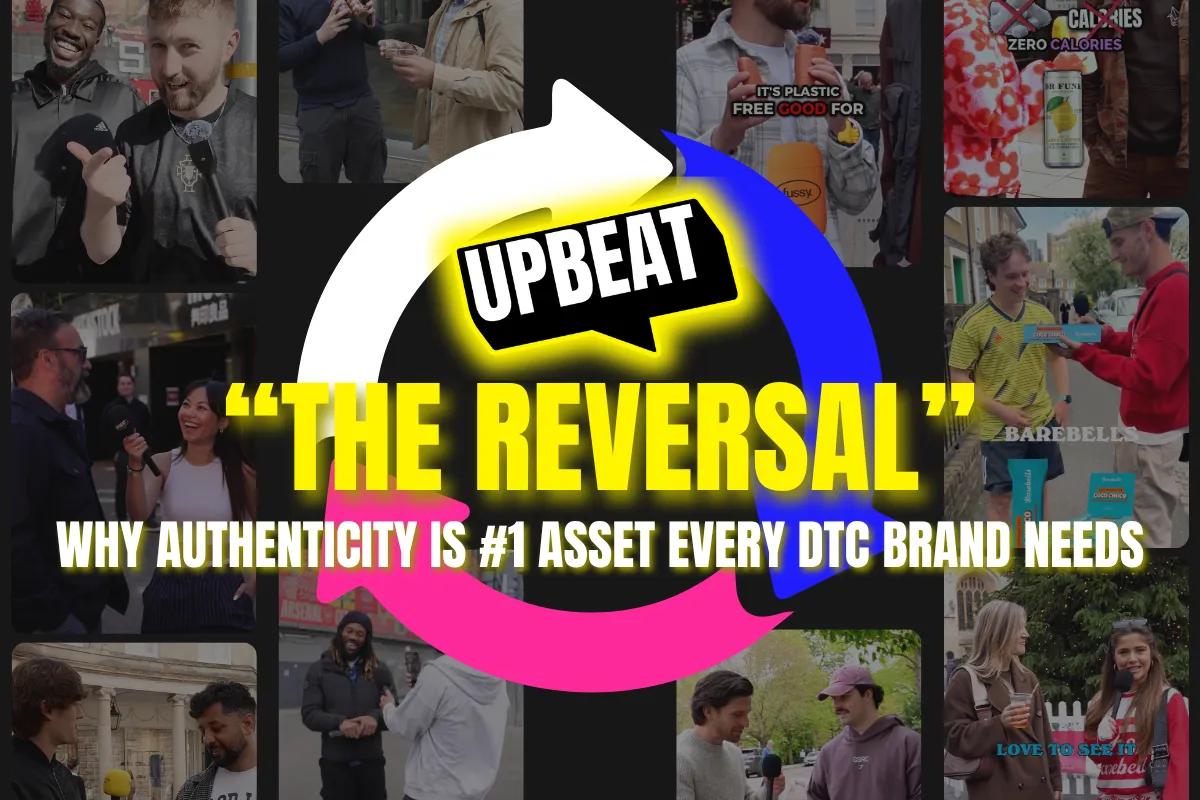
UPBEAT is the UK's #1 street interview ad agency. 2,500+ street interviews. 120+ brands, from high-growth DTC names through to NFL, Fussy, Barebells, Wise, ForGoodnessShakes, Little’s Coffee and Semrush. 1 billion+ views delivered. 2.88x average ROAS. 33% lower CPA. We've spent four years turning this format into a measurable performance channel.
Why The Format Wins: The Psychology Of A Real Reaction
This isn't about lighting. It isn't about being on a busy street. It isn't even about the question being asked. Man-on-the-street ads win because they hijack three psychological mechanics that polished UGC, AI slop and influencer content can't replicate.
One. The curiosity gap. A stranger gets asked a real question on camera. The viewer immediately has two thoughts. What are they going to say? And what would I say if someone asked me that? That internal tension forces the scroll to stop.
Two. The chaos factor. Polished ads are predictable. AI slop is predictable. The same three creators advertising for twelve competitors this month is predictable. Street interview ads are not. A stutter. A laugh. A detail a brand would never think to write. That's the stuff that makes a viewer believe a human is talking to them.
Three. Unbiased social proof. A paid creator has a financial incentive to sell the product. A random stranger in Manchester does not. Someone in London picks up where she left off. A nineteen-year-old in Bristol disagrees with both of them. That's social proof at scale, and it's the one thing no studio, no influencer roster and no AI tool can manufacture.
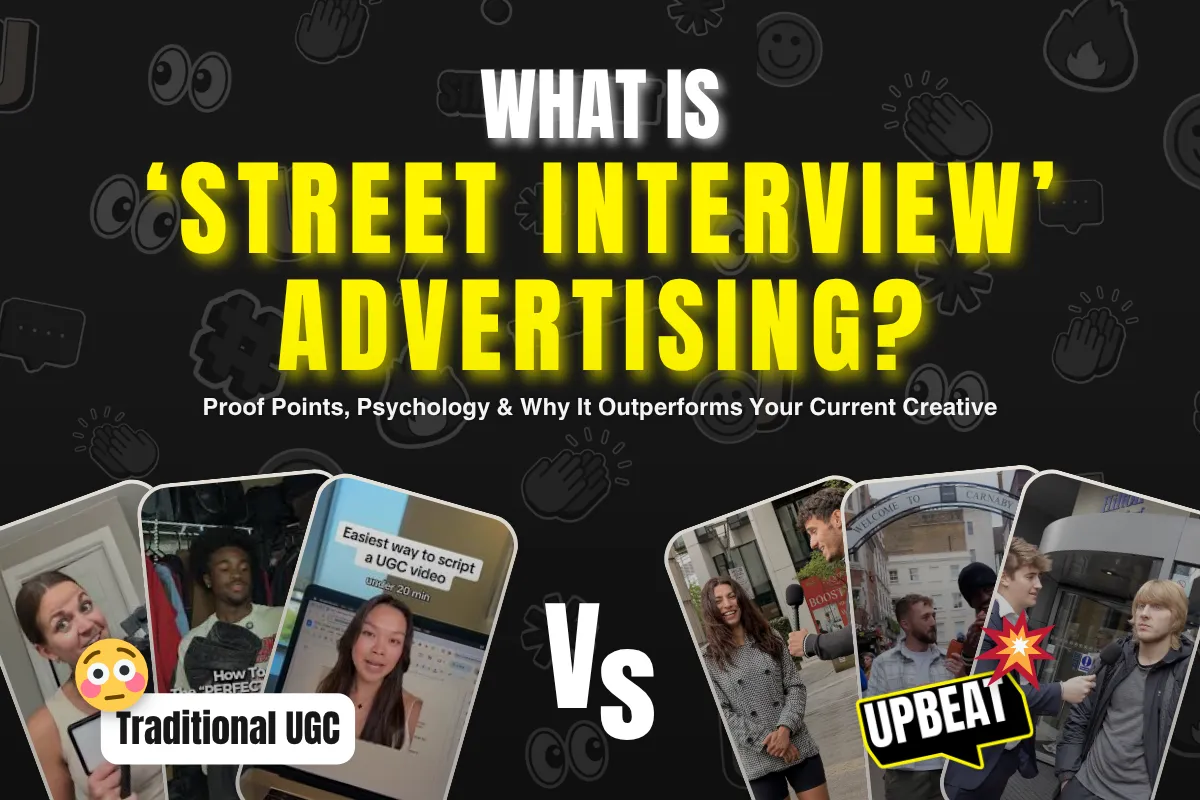
Street Interview Ads vs. Traditional UGC
Polished UGC used to feel authentic. It stopped feeling that way the moment creators started charging £1,500 for a 60-second clip. Here's how the two compare when deployed in a live Meta or TikTok ad account.
Metric
Traditional UGC
Man-On-The-Street Ads
The talent
Paid creators
Real strangers on UK streets
The script
Pre-written talking points
Unscripted prompts
Trust signal
Low — viewers see the transaction
High — viewers see a peer
Variety
Same creator pool, same backgrounds
Different presenter, city, participant, reaction
Hook rate
Flatlining
Built for 6-second hold
CPA performance
Benchmark
Up to 33% lower
ROAS
Plateauing
2.88x average across 120+ brands
UGC tells consumers what to think. Vox pops show what consumers actually think. That's the gap. It's also the entire reason the format converts where everything else has stalled.
The Six-Part Framework Behind A Street Interview Ad That Performs
Most brands try to copy the look of a man-on-the-street ad and miss what makes it work. The format isn't the visual. It's the structure underneath. Every winning street interview ad we ship follows six steps.
- Pattern interrupt. A visual or verbal hook in the first second that breaks the scroll.
- Public intercept. A real person in a real, uncontrolled environment. UK high street, not a studio backdrop.
- Open-ended prompt. A question engineered for curiosity. No yes-or-no answers, no leading questions designed to flatter the brief.
- Authentic reaction. The unscripted moment of thinking. The pause. The laugh. The honest opinion.
- Contextual product integration. The brand enters the conversation when it earns its place. Not in the first three seconds.
- Social proof loop. Multiple stranger reactions stacked in the edit. Peer-to-peer credibility, compounded across the asset.
Get those six right and you have an ad that holds for 6 seconds, retains for 15, and converts. Get one wrong and you've made a video. We do not make videos. We make paid creative that moves dashboards.
Why "Control" Is The Wrong Goal
The most common pushback we hear from marketing leads is that the format feels risky. Handing a microphone to a stranger sounds like a budget about to go sideways. That instinct is the exact reason most brands are stuck.
The actual financial risk isn't the unpredictable reaction. The actual risk is spending your entire quarterly creative budget on ads that audiences ignore inside three seconds. A perfectly controlled script is exactly what makes a 2026 consumer scroll past. Giving up that control isn't reckless. At a £10k+ monthly paid social spend, it's mathematically the safest bet on the board.
Why The Format Wins In The Age Of AI
AI tools don't just reward content. They reward information gain. They're hunting for new opinions, real experiences and unscripted human data they can't generate themselves.
Every street interview ad we ship is a piece of primary-source human insight. It can't be hallucinated, can't be averaged into nothing, can't be trained out of existence. That's what makes vox pops uniquely valuable for paid social algorithms today and AI-driven discovery tomorrow.
Frequently Asked Questions
What is a man-on-the-street interview? A man-on-the-street interview is an unscripted conversation with a real stranger in a public location. Brands use the format to capture honest opinions, product reactions and unbiased social proof for paid social campaigns.
Are street interview ads effective? Yes. Across 120+ UPBEAT clients, street interview ads have driven 2.88x average ROAS and 33% lower CPA versus standard creative benchmarks. They consistently outperform polished UGC, AI UGC and influencer content on paid social.
How are vox pop ads different from influencer marketing? Influencer marketing relies on paid endorsements from recognisable creators. Vox pop ads rely on unscripted, unbiased reactions from real strangers with no financial incentive to praise the product. One builds awareness. The other converts.
What platforms work best for man-on-the-street advertising? Meta (Facebook and Instagram Reels) and TikTok. The format is native by default — vertical, fast, conversational — which is exactly what both algorithms reward in 2026.